BLA’s announcement of the QAHR (Qazi Aero Hive Rangers) unit represents a deliberate attempt to formalize an ‘air and drone warfare’ wing within the organization. In BLA’s own narrative, QAHR is presented as the first Baloch ‘air unit,’ linked symbolically to a senior commander figure known as Qazi and branded with a distinct emblem and color scheme. The timing of the announcement, immediately after the group’s multi-site ‘Operation Herof 2.0,’ is significant: it allows BLA to retroactively frame any UAV-related experimentation around Gwadar and other sites as the work of a specialized structure rather than ad hoc fiddling. In communication terms, the unit is therefore as much a signaling device as it is a real capability: it tells supporters, adversaries and potential recruits that BLA is moving into a multi-domain era.
BLA link the unit directly to a senior commander figure, Abdul Basit Zehri, alias ‘Qazi,’ portrayed as an early advocate of scientific resistance, small-team innovation and the use of modern technology in the insurgency. As per Baloch sources, he is described as the conceptual patron of the project, and QAHR is explicitly glossed as ‘Qazi Aero Hive Rangers’ – a formulation that fuses his nom de guerre with the vocabulary of air power and networked, swarm-style action. Even where his exact current operational status is unclear, BLA-aligned messaging increasingly casts Qazi as the architect of the air unit, turning him into a symbolic bridge between the older guerrilla generation and a younger, tech-oriented cadre. The word QAHR itself, with its connotations of wrath, overwhelming force and divine-style punishment in Urdu and Balochi usage, is not accidental: it is meant to suggest that the skies above Balochistan now carry an element of calculated retribution directed at what the group calls occupying forces (Pakistan Army) and their partners (particularly China).
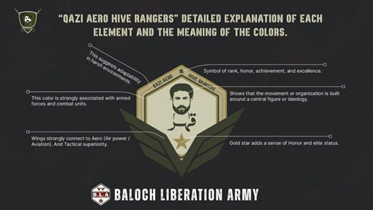
The unit’s emblem and visual language reinforce this layered messaging. Hakkal Media’s explainer frames the QAHR logo as a shield-like crest flanked by stylized wings and crowned with a single star. The shield is described as representing disciplined defense of Baloch land and the institutionalization of the unit as a proper corps rather than an improvised cell. The wings signal the entry of the movement into the aerial domain, and are often depicted in a slightly forward-swept posture, suggesting speed, reach, and the ability to strike from unexpected angles. The lone star at the centre is presented as a mark of elite status within the broader organization – a visual claim that QAHR is a vanguard formation whose tactics and ethos other units should emulate. Dark, military-style tones in the background, contrasted with lighter or gold accents on the star and wings, are explained in propaganda material as symbolizing resilience under pressure and the emergence of sophisticated capability out of a harsh, oppressive environment. For sympathizers and potential recruits, this package of name, acronym, and logo is designed to make QAHR look less like a small technical section and more like a distinct, prestigious brand within the insurgency, one that promises not just participation in armed struggle but membership in an ostensibly modern, technologically literate ‘aero hive’ tasked with taking the fight directly to Chinese critical infrastructure and Pakistani security installations.
Structurally, QAHR is likely to be a small, compartmentalized formation nested within BLA’s existing military commission rather than a mass force. The working model is a three-tiered structure: a core ‘technical cell’ of a handful of operatives with basic engineering or IT backgrounds; a small ‘operations cell’ embedded with selected ground units for mission integration; and a ‘media/documentation cell’ responsible for filming, post-production, and dissemination of drone footage.
In capability terms, QAHR is unlikely, at least in the near term, to field large, military-grade UAVs. These can be used in three principal roles: short-range reconnaissance (pattern-of-life studies of checkpoints, patrol routes, and static installations); battle damage assessment and media collection (recording attacks for propaganda); and limited direct-action missions using improvised aerial-dropped charges. Current payloads, by weight, would restrict QAHR primarily to harassment attacks—damaging vehicles, light structures, fuel storage or sensor equipment rather than destroying hardened infrastructure. However, even modest explosive weights, accurately delivered onto soft targets such as parked vehicles, guard posts, or unarmored accommodation, can produce both casualties and psychological shock disproportionate to the material effect.
Operationally, the creation of QAHR offers BLA three major enhancements to its campaigns. First, it extends the group’s ISR (intelligence, surveillance and reconnaissance) horizon. Instead of relying solely on physical reconnaissance or human informants, BLA fighters can now use drones to quietly map security perimeters, identify blind spots in watch towers, and monitor troop rotation or convoy schedules without exposing scouts to immediate detection. Second, it allows the group to coordinate more complex, multi-axis attacks. In Gwadar operation, for example, ground assault teams were guided by real-time aerial feeds, while small drones probe for weak points, trigger diversions by hovering over one gate while a main attack develops elsewhere, or even attempt to drop small charges onto perimeter positions to overload defenders. Third, QAHR gives BLA a new psychological warfare tool: drone footage of attacks, convoys under observation, or close passes over sensitive facilities, once edited and pushed through Hakkal Media and other channels, reinforces the narrative that ‘no target is out of reach’ and that state and Chinese assets are permanently within BLA’s line of sight.
For Chinese critical infrastructure in Gwadar, the emergence of QAHR shifts the threat landscape in several ways. Gwadar’s deep-sea port, free zone, Chinese residential and office compounds, and associated energy and communication nodes are high-value, symbolically loaded assets. These facilities already operate under a regime of physical security and perimeter control, but their vertical dimension—rooftops, open yards, exposed equipment, and movement corridors—remains inherently vulnerable to small UAVs. QAHR’s presence means that Chinese project sites, construction yards, vehicle parks, and workers’ accommodations could be subjected to persistent low-cost surveillance, enabling BLA to track routines, identify vulnerable transit windows, and plan attacks or demonstrations timed to maximum political effect. Even a single, low-casualty drone incident against Chinese personnel or property, if captured on video and framed as part of a ‘Baloch air war against occupation,’ would have outsized strategic impact: it would resonate in Chinese domestic debates on overseas risk, bolster BLA’s international propaganda, and put pressure on Islamabad to deliver visible security improvements quickly.
Beyond direct kinetic and ISR roles, QAHR also contributes to BLA’s internal and external legitimacy. Internally, it offers a career path and status marker for literate, technically minded youth who might otherwise be ambivalent about classical guerrilla life. It signals to fighters that the organization is capable of adaptation and is not trapped in a 1990s playbook. Externally, QAHR allows BLA to position itself alongside other insurgent movements in the region and beyond that have weaponized commercial drone technology, thus participating in a transnational insurgent ‘learning loop.’ This has implications for counter-terrorism cooperation: regional adversaries of Pakistan may quietly celebrate or amplify narratives of BLA’s technological evolution, while sympathetic diaspora networks may be incentivized to experiment with components, software, and funding streams that can be leveraged by QAHR.




No Comments