The Geostrategic map spanning Pakistan, Afghanistan, Iran, and Central Asia is undergoing a harsh transformation. As China is pushing its economic roots deeper into South and Central Asia, it is discovering that its partnerships and massive infrastructure projects are increasingly attracting a complex web of regional instability. The concept of a “Eurasian Strangulation” is not just a theoretical risk but in fact it is a dissection of the current security challenge Beijing is facing.
CPEC under Siege
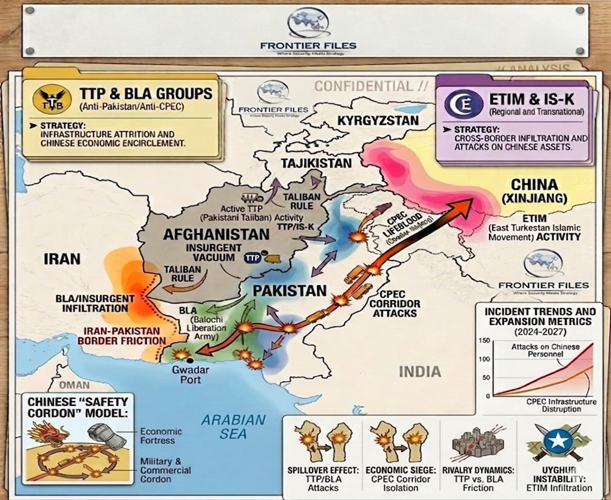
The China-Pakistan Economic Corridor (CPEC), a crucial multibillion-dollar project intended to avoid the Malacca Strait, is at the center of China’s regional strategy. However, above given map highlights a disturbing trend of “infrastructure weakening” along this route. The Gwadar Port, once pictured as a crown jewel of the Belt and Road Initiative (BRI), is now the center point for coordinated attacks by groups like the Balochistan Liberation Army (BLA), Baloch Republican Army (BRA) and other ethno-nationalist groups.
The BLA’s “Operation Herof 2.0,” began in early 2026, represents the next level of insurgency specifically targeting Chinese interests. The Balochistan Liberation Army (BLA) has shifted from low-intensity, hit-and-run tactics to sophisticated, large-scale urban attacks and also coordinated suicide operations specifically targeting Chinese nationals and economic assets. By striking the vital routes of supply & logistics, these groups are not just fighting the Pakistani state but also using “economic encirclement” to built pressure on Beijing that the strategic advantages of its presence are outweighed by the costs.
The Afghan Vacuum and Transnational Blowback
The scenario in Afghanistan reflects a broader systemic failure of regional diplomacy, even as CPEC faces operational disruption on the ground. The withdrawal of allied forces from Afghanistan left a huge vacuum for insurgents whom the Taliban has badly failed to control. The border between Pakistan and Afghanistan has ended up into an open conflict zone rather than being a bridge for regional connectivity.
Beijing’s efforts to break a peace between Islamabad and Kabul has been badly failed and ended in cross border military strikes or “open war” along the Durand Line. The Urumqi trilateral peace talks till now have failed, although Afghan officials quote them as going positive but their actions and the cross border attacks in Pakistan have increased significantly says otherwise. This unrest serves as a breeding ground for international terrorism. Groups like Tehreek-e-Taliban Pakistan (TTP), Islamic State-Khorasan Province (IS-KP) and East Turkestan Islamic Movement (ETIM) use this as an opportunity and keep safe heavens in the borderlands to recruit, radicalize and plan cross border attacks which directly threatens China’s great power game.
The Fragility of the “Safety Cordon”
To counter these threats, China adopted what the map calls a “Safety Cordon” model, an effort to keep its economic fortress encircled with military or commercial protection. The recent conflict between the US, Iran and Israel has further complicated regional stability, especially closing the energy flows through the “Strait of Hormuz” and the territorial security of the Iran-Pakistan border.
Pakistan on the other hand is also finding it difficult in keeping its part of the bargain as Pakistan itself is stuck between local ethno-nationalist groups and the Taliban. Early in 2026, foreign direct investment (FDI) fell precipitously from $1.4 billion to just $808 million, which was a clear sign that the “economic security” growth model is under extreme pressure.
The Invisible Hand: Washington’s Counter-Containment
The shadow plan between China and the US actively fosters this regional unrest. The US has adopted this strategy of counter containment and thus avoiding direct military engagement. Rather than attempting to match China dollar-for-dollar in infrastructure spending, the US utilizes economic, diplomatic, and financial leverage to disrupt Beijing’s ambitions.
US also keeps a tight control on Pakistan’s financial situations and time to time exploits it through western dominated institutions like the IMF. Thus by stricter transparency requirements on its sovereign debt, Pakistan is forced to choose between honoring Chinese commercial loans and maintaining liquidity through Western bailouts. At the same time, tight US sanctions on Iran and the financial isolation of Afghanistan maintain a permanent economic dead-zone in China’s backyard.
The Dual Threats Confronting Beijing
China has invested more than $65 billion into Pakistan. Now, pulling out due to security threats I is not an option for China as it signals global weakness, severely damaging the credibility of the entire BRI. However in order to succeed China did tried to bargain some in past like establishing private security outposts but with existing local backlash and neocolonialism was unsuccessful. In simple words, US is keeping China on volatile and chaos managed land corridors leaving is exposed in the sea.
Conclusion
China’s goals in the region are now facing a much more dangerous and unstable situation. The old idea of achieving peace through economic development has been replaced by ongoing conflict and instability, where Chinese workers, projects and international reputation are increasingly being targeted. If tensions between China’s regional partners continue to grow and insurgent groups keep attacking despite government security efforts, China could discover that its plan to build a strong economic network has instead created a series of costly and vulnerable positions stuck in long-term political and security problems.



No Comments